
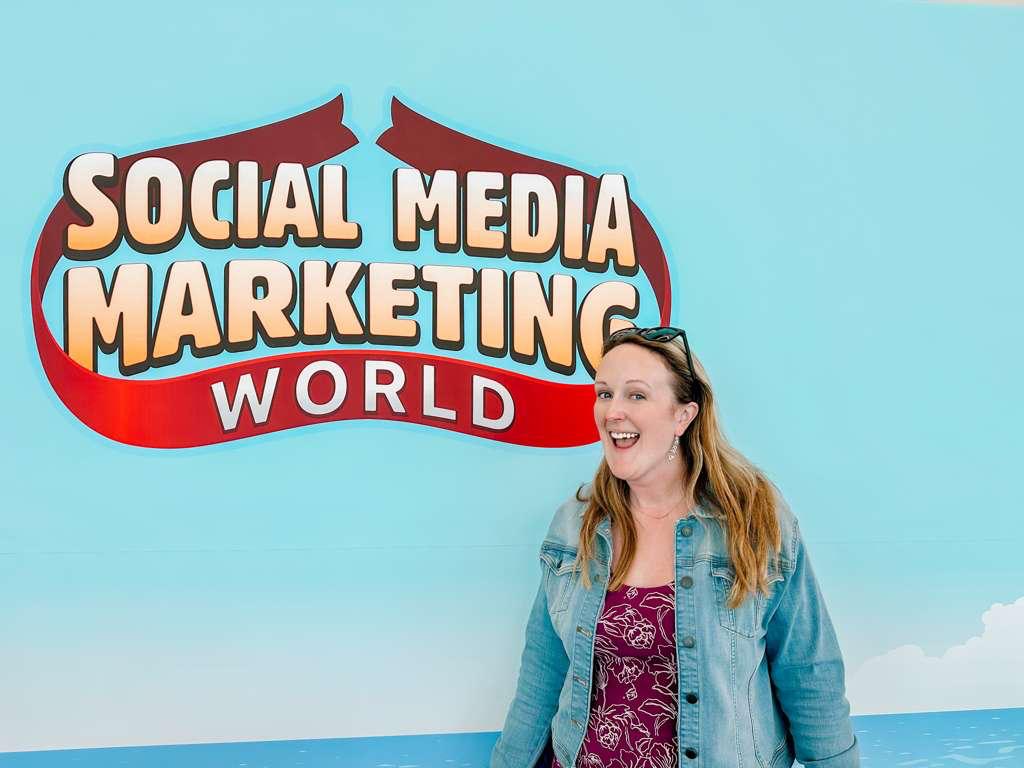
Wow. Just… wow.
I’ve been attending Social Media Marketing World long enough to know what to expect: the hallway conversations that run way too long, the notebooks full of ideas that explode your brain by Day 2. But this year felt extra special — I had the privilege of volunteering and supporting many of the incredible speakers I’m about to share with you. Getting a behind-the-scenes peek at how this event comes together, and cheering on speakers I genuinely admire, made the whole experience even more meaningful.
And in true “it’s a small world” fashion (yes, we were right next door to Disneyland), I also hosted a meetup for fellow authors at the event. What started as a casual gathering turned into one of my favorite moments of the whole conference. We connected, swapped stories, and quickly realized just how incredibly small the book space really is.
The right room changes everything.
Hey, new friends 👋🏻
Now — on to the good stuff. Because the sessions this year? They delivered.
The Thread That Ran Through Everything
Before I dive in, I want to name the theme I kept hearing across every single stage: the humans still win.
AI is an accelerant, not a replacement. Authenticity isn’t optional anymore — it’s a competitive advantage. Story is the strategy. And connection? Connection is the whole point. Every speaker said it differently, but they were all saying the same thing.
Let’s get into it.
Consistency Beats Virality Every Time
One of the most grounding sessions of the conference came from a creator who committed to showing up — repeatedly, persistently, episodically — and tracked what happened over 365 days. The results were staggering. But the lesson wasn’t about the numbers.
It was about the structure behind the content.
The big idea: people don’t just watch content — they follow stories. When your content is built like a series, with anticipation baked in and a payoff promised, your audience has a reason to come back. Every. Single. Time.
The mindset shift that hit me hardest? Stop counting views. Start counting uploads. Volume and consistency, done with intention, compound over time in ways that a single viral moment never could.
Your AI System Should Work While You Sleep
This session was the one that had everyone in the room reaching for their notebooks. The core idea: AI works best when it’s part of a system, not just a tool you occasionally poke at.
Think of it in layers — a place where your content lives and stays organized, a place where the thinking and drafting happens, and an automation layer that connects it all and runs it. And then there’s the most important layer of all: you. The human checkpoint that reviews, refines, and hits publish.
The goal of AI isn’t to remove you from your business. It’s to remove you from your task list so you can focus on the work only you can do.
The aha moment here: when your system is built well, content shows up in your inbox ready to review — instead of you staring at a blank screen wondering what to post.
One Strong Story, Multiplied
What if you didn’t need a big budget, a fancy camera, or a full production team to create compelling video content? This session proved you don’t.
The framework is simple — and it’s the same one Hollywood has used for a hundred years. Pre-production (your story), production (your tools), post-production (edit and scale). AI didn’t change the structure. It just made it faster and more accessible.
The part that stopped me in my tracks: strong content always comes down to three things — a person, a pain, and a solution. That’s it. Your product or service is just the mechanism that connects the two.
The real magic happens in post-production. One strong story can become ten versions and fifty possibilities. Before AI, you had one shot. Now you multiply.
Stop Dabbling. Start Investing.
YouTube is harder than ever — and the creators who are winning aren’t the ones who got lucky. They’re the ones who made a decision to treat their channel like a business.
The Sean Cannell session’s most quotable line: “Content is king, but packaging is queen — and she runs the household.”
The insight that reframed everything for me: views are almost beside the point if they’re the wrong views. A tiny, highly engaged audience that trusts you will always outperform a massive audience that doesn’t. The goal isn’t more eyeballs. It’s the right eyeballs — people who are ready to go deeper with you.
And the reminder I needed to hear: YouTube rewards businesses willing to invest, not dabble. That means showing up with intention, building a team around the work, and treating every video like it has a job to do. YouTube is a place that I know I’ve been dabbling in for years, and this year is where I start to get consistent with shorts first before doubling down into long form.

It’s Not a Content Problem. It’s a Connection Problem.
This was the session that felt like a permission slip.
If your content has been feeling flat lately — if you’ve been following all the “rules” and still not getting traction — this speaker had the diagnosis: you’re not creating a connection. You’re creating content. And there’s a big difference.
The old rules (post value, stick to your niche, talk like an expert) have quietly been replaced. The new rules? Show your identity. Make it obvious who belongs here. Make people feel seen. Talk like a human.
The reframe that I keep coming back to: it’s never about the thing. A recipe isn’t a recipe — it’s a lived-in moment someone desires. A workout isn’t a workout — it’s belonging. A haircut isn’t a haircut — it’s a relationship. When you lead with the feeling instead of the feature, everything changes.
And the most honest thing said on any stage all week: “AI can’t replace a lived-in experience.”
We are in a trust recession and a connection era at the exact same time. The antidote isn’t more content. It’s more you.
Less rules. Back to basics.
What I’m Taking Home (and Actually Doing)
Every year I leave SMMW with a list. This year it feels less like a to-do list and more like a compass. Here’s what I’m committing to:
Watch the recordings and share key moments with my team and clients.
Audit my content — am I making people feel seen, or just informed?
Map out a content series with anticipation built in — give my audience a reason to come back.
Build out my AI system stack — layer by layer, starting with what already exists.
Reframe my packaging — does my content stop the scroll in the first 30 seconds?
Follow up with every person I connected with — in the sessions, the meetup, and the hallways. Because that’s always where the real magic happens.
If SMMW 2026 taught me one thing, it’s this: the tools are getting faster, but the humans who know how to make other humans feel something will always have the edge. That’s not new. We’re just being reminded of it.
See you next year. 🎢
Want to keep the conversation going? Connect with me on LinkedIn — I’d love to hear what resonated with you!