
What does Dancing with the Stars have to do with parenting advice?
At first glance, absolutely nothing.
One involves sequins, spray tans, and celebrities attempting the cha-cha. The other involves helping parents navigate tantrums, power struggles, and the everyday challenges of raising kids.
But somewhere between the ballroom and the bedtime battles, there’s a connection.
And finding connections like that? It’s one of my favorite parts of being a social media strategist.
Recently, my team and I turned a Dancing with the Stars pop culture moment into an Instagram carousel for our client, Positive Parenting Solutions.
The results were pretty darn impressive:
- 407,000+ views
- 315 comments
- 192 new followers
All from ONE Instagram carousel.
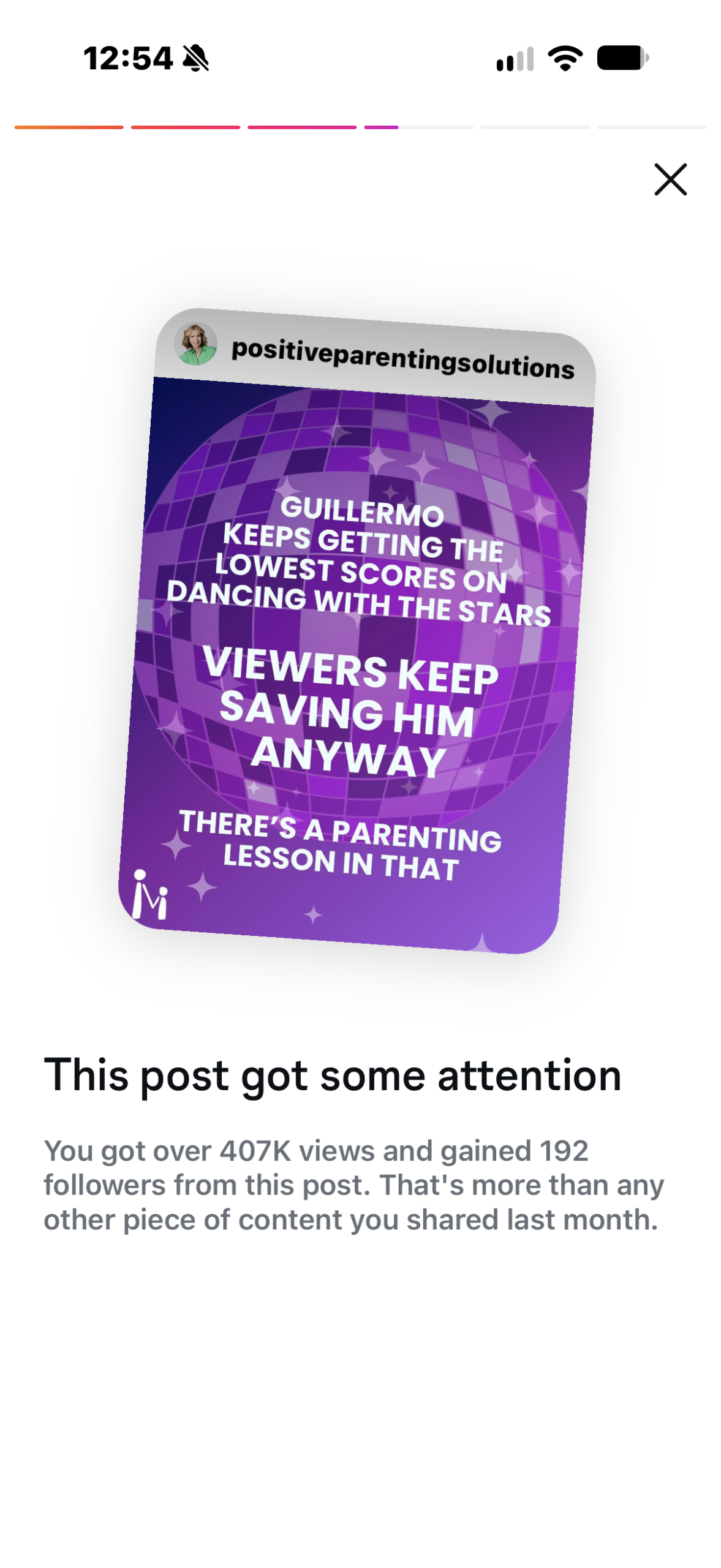
Instagram’s own recap: the DWTS carousel was the top post of the month.
Now, before you chalk that up to a lucky viral moment, there’s something you should know.
This wasn’t our first rodeo.
We’d previously used another timely topic to create a high-performing post for this same client. That one pulled in over 229,000 views and 890 new followers.
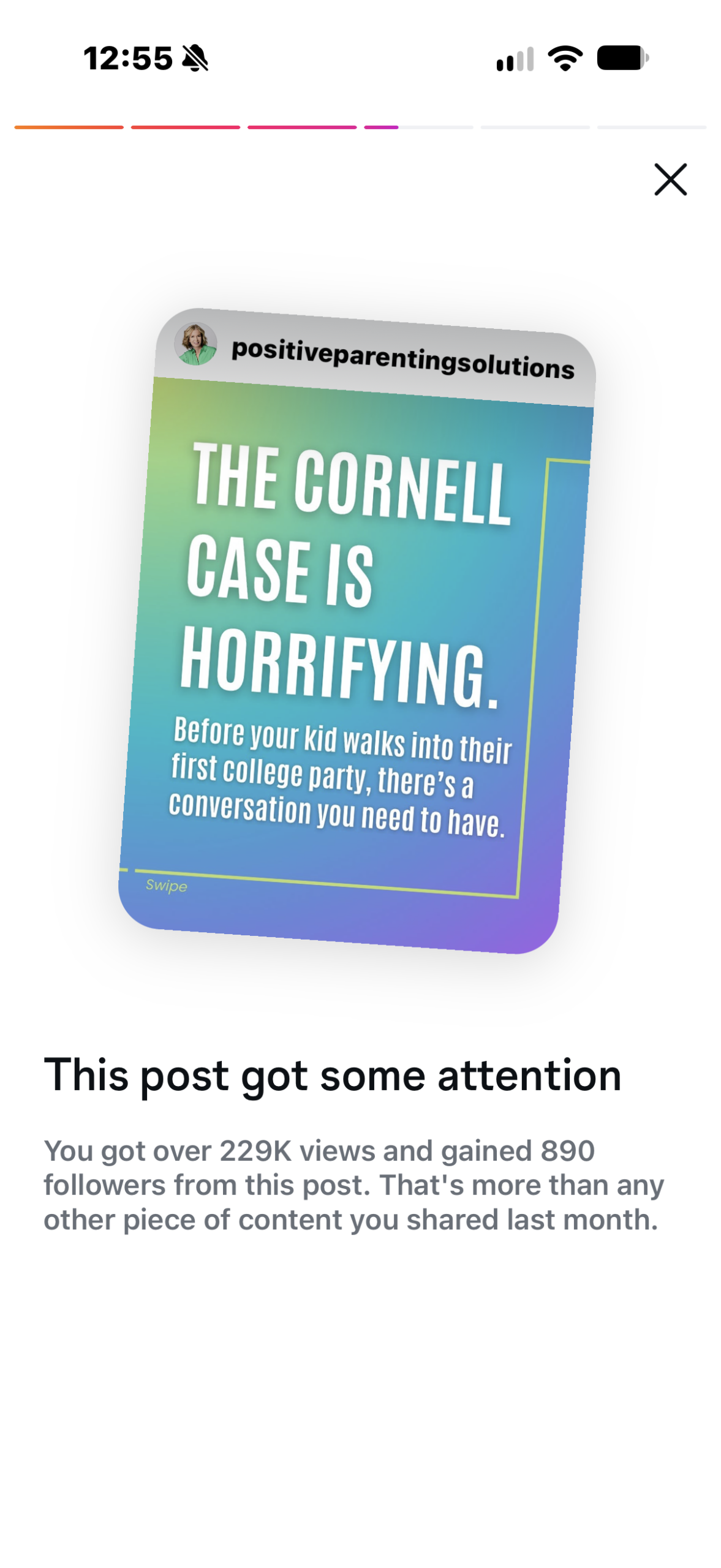
Different conversation. Same strategic approach.
And that’s exactly what I want to talk about today.
Because while you can’t guarantee a post will go viral, you CAN create a repeatable process for identifying opportunities, connecting them to your expertise, and making content people actually want to consume.
I call it my Content Trifecta. And it comes down to three T’s: Timeliness, Tip, and Type.
It Started With a Conversation That Had Nothing to Do With Parenting
One of the biggest misconceptions I see in content marketing is that every post needs to start with your business.
If you’re a parenting expert, you should talk about parenting. If you’re a financial advisor, you should talk about money. If you’re an author, you should talk about your book.
And sure, your expertise should absolutely be reflected in your content. But here’s where I think people get stuck.
They assume the SUBJECT of their content always needs to be their area of expertise. Sometimes, the best way to introduce someone to what you know is to start with something THEY already know.
- A television show they’re watching. Like Dancing with the Stars.
- A celebrity everyone’s talking about. Like Kim Kardashian trying on Elizabeth Taylor’s diamonds from the vault.
- A sporting event that has people glued to their screens. Like the World Cup or the Super Bowl.
- A news story that’s dominating conversations. Like the midterm elections (though you’ll want to steer clear of this one in some cases).
These moments already have people’s attention, so your job isn’t necessarily to create a brand-new conversation. Sometimes, it’s to find a meaningful way to contribute to one that’s already happening. Add those two cents.
So we took a TV show that was getting a lot of buzz online and lined up with our parenting audience: Dancing with the Stars (DWTS). People were sharing their thoughts on the judges, the stars, and the themed routines week after week. The cultural familiarity was already there. Rather than just jumping on the trend, we asked a more important question: how can we connect this moment to something our client’s audience actually needs to hear?
And that’s where this strategy began.
Pro tip: If it takes you more than 20 minutes to brainstorm an alignment opportunity, please don’t try to force it.
The Content Trifecta: Three T’s That Make Timely Content Work
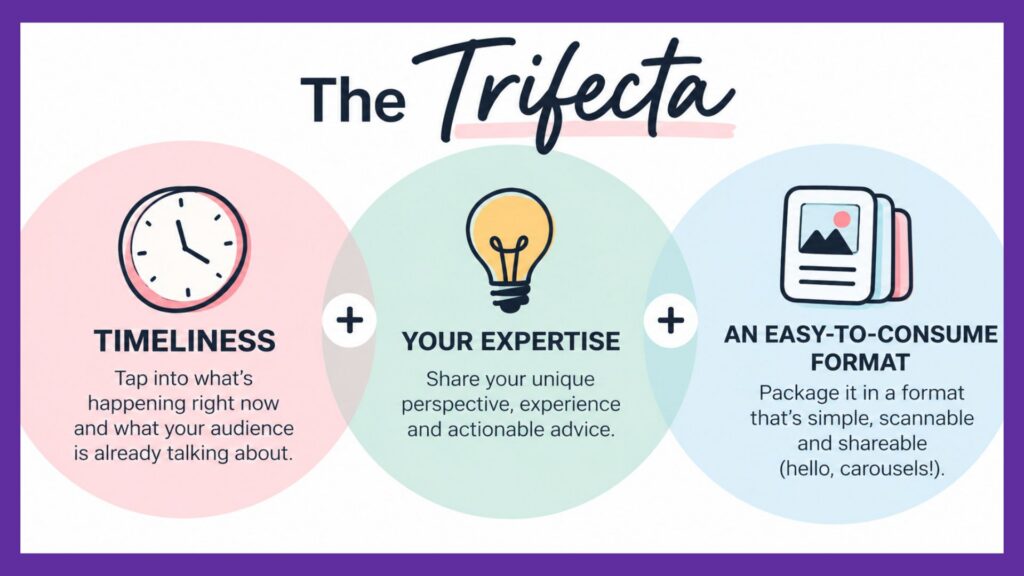
Over the years, I’ve developed a framework for approaching these opportunities. It’s simple enough to remember, but strategic enough to help you think differently about the content you’re creating.
T #1: Timeliness. Find the Conversation That’s Already Happening.
Timeliness is about paying attention to what’s happening around you.
Take note of the hot takes around pop culture, current events, entertainment, sports, or even your local community. What is gaining traction and sparking heated discussion with your audience?
The important distinction here is that timely doesn’t automatically mean relevant. Just because something is trending doesn’t mean your business needs to post about it. In fact, please don’t. Your audience can tell when it feels awkward and forced.
Instead, look for moments where there’s a natural bridge between the conversation and your expertise.
With Positive Parenting Solutions, Dancing with the Stars gave us a recognizable cultural reference point.
The opportunity wasn’t to become a ballroom dancing account for the day. It was to take the conversation around the show, about one star advancing week after week while more skilled stars were getting sent home, and pull out the lesson. A parenting lesson surfaced easily from that widespread discussion among DWTS fans (many of whom are moms and dads).
We’d also done something like this before, leaning on a topic that was all over the internet and being discussed by our client’s audience specifically. That earlier success mattered because it reinforced something I’ve believed for years:
You don’t have to manufacture attention when you know how to connect your expertise to conversations that already have it.
T #2: Tip. Bring Your Expertise to the Table.
Get out your wands, people. This is where the magic happens. And frankly, it’s the step I see people skip most often.
They spot a trending topic, create something vaguely related to it, and hope the algorithm rewards them. Oof! But as I mentioned earlier, relevance is the key. Without it, the content falls flat and you’re left wondering why.
Sure, you’ll likely get some inflated views and a few comments. But does anyone walk away understanding what you know, who you help, or why they should click that follow button to hang out with you longer?
That’s where the TIP comes in. Your tip is the lesson, perspective, or insight that connects the timely conversation back to your expertise. It has to be obvious, quick, and easy to grasp.
For Positive Parenting Solutions, that meant using the familiarity of Dancing with the Stars as an entry point into a parenting conversation. Here’s how it broke down:
- The show was the hook.
- The parenting expertise was the value.
- The call to action invited people to follow along (and that they did!).
We used a television show to make parenting advice more approachable, more relevant, and dare I say even entertaining. That’s the main reason many people flock to social media to begin with: to be entertained!
Think about how this could work for your own business. A few examples to get the wheels turning:
- If you’re a leadership consultant, a high-profile coaching decision during a major sporting event could open a discussion about team dynamics.
- If you’re a financial advisor, a celebrity’s extravagant purchase might open the door to a conversation about spending habits.
- If you’re a nonfiction author, a headline related to your book’s subject could be the perfect opportunity to share a lesson from one of your chapters.
The possibilities are everywhere. But the question should always be the same: What can I teach my audience through this moment? Your expertise is what turns a trending topic into strategic content.
T #3: Type. Make the Content Easy to Consume.
Now that you’ve identified the timely conversation and the lesson you want to share, it’s time to decide how to package it.
You can have the most brilliant insight in the world, but if people have to work too hard to understand it, you’ve already lost them.
For our Dancing with the Stars post, we chose an Instagram carousel. That’s where we’ve had the most success with Trifecta-style content for Positive Parenting Solutions. Here’s the carousel if you want to take a peek. The slideshow format let us take a recognizable cultural moment and guide people through the connection to our client’s expertise, one slide at a time.
But here’s where the story gets interesting. ChatGPT actually suggested a different visual approach. It suggested judges’ paddles.
And my immediate reaction? Nope. We’re not doing that.
Not because AI had given us a terrible idea. It simply wasn’t the strongest choice for this particular audience, or the most quickly recognizable. We went with a mirrorball (the disco ball trophy) instead.
When someone is scrolling through Instagram, you have a split second to capture their attention. If they recognize something they already know, they’re more likely to stop and investigate. That’s not a guarantee of engagement, of course.
But it is one more intentional decision that can help your content connect. And it’s a perfect example of why I constantly remind business owners: AI is a sounding board, not your final decision-maker.
We love our friends ChatGPT and Claude. They can help you brainstorm, organize your thoughts, and explore creative directions. But candidly, they don’t automatically know your audience better than you do. They haven’t spent years observing your customers, listening to their questions, or understanding the subtle details that make something resonate.
That knowledge is valuable. Please never forget that! And you shouldn’t hand it over just because a robot confidently suggested something different.
So, Was It the Algorithm? The Trend? The Visual?
Let’s talk about those 407,000 views for a second. Whenever a post performs exceptionally well, people naturally want to know the secret.
- Was it the trending topic?
- The carousel format?
- The visual?
- The timing?
My answer is that it wasn’t any single one of those things. It was the combination of intentional decisions.
- We identified a timely conversation.
- We naturally connected it to our client’s expertise.
- We selected a format that made the message easy to understand and share.
- And we made creative decisions based on what we knew about the audience.
That’s the Content Trifecta in action. It’s gold, baby!
And the ripple effect showed up across the whole account. In October, Positive Parenting Solutions saw 786K views (up 124% from September), 71% of those views came from non-followers (up 260%), and the account gained 2,382 new followers.
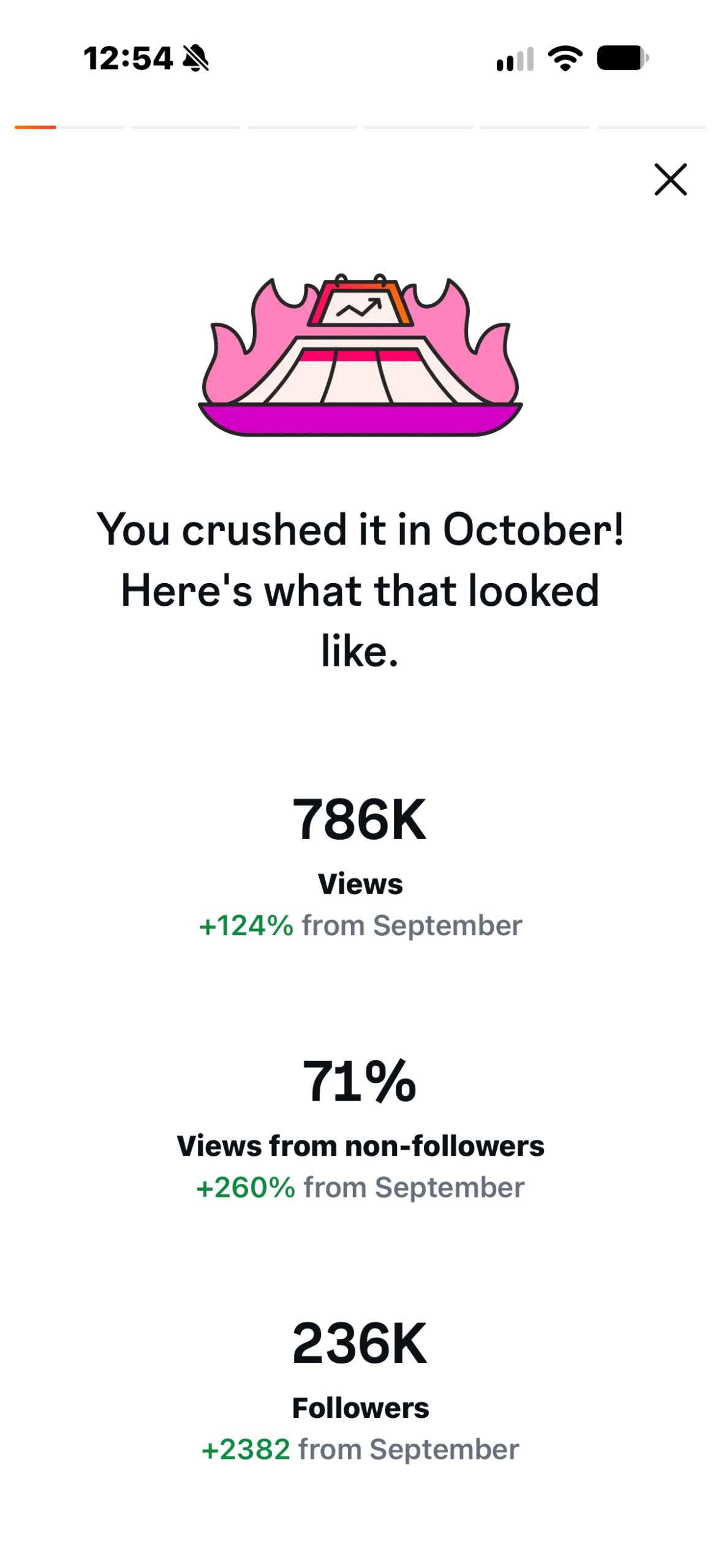
October at a glance for Positive Parenting Solutions.
Now, there is no magic formula that guarantees 407,000 views. If there were, I’d be a bajillionaire (probably).
Social media doesn’t work that way, no matter what the latest algorithm guru might promise you.
But there is a difference between throwing content at the wall to see what sticks and building a strategy that gives your content a stronger chance of connecting.
And when you’ve used a similar approach successfully more than once, it’s worth paying attention to the pattern AND the process behind it.
What This Means for Your Content Strategy
Here’s where I want to challenge you.
The next time you’re staring at your content calendar wondering what to post, don’t immediately open ChatGPT and ask it for 30 content ideas. And don’t assume you need to create something completely original from scratch.
Instead, pay attention to what’s happening around you. What are people talking about? What’s showing up in your newsfeed? What conversations are happening outside your industry that might have an interesting connection to your expertise?
Then run those opportunities through the Content Trifecta.
TIMELINESS: Is this something people are already paying attention to?
TIP: Do I have a relevant lesson, perspective, or piece of advice to contribute?
TYPE: What’s the easiest, most engaging way to communicate that lesson?
If you can’t find a meaningful connection to your expertise, skip it. Not every trend needs your two cents. Seriously.
When you DO find that connection, don’t dismiss it just because the topic seems unrelated to your business. Sometimes the most unexpected connections make the most memorable content: the kind that gets you seen, heard, followed and yes, paid.
Ready to Put the Content Trifecta to Work?
You don’t need another list of generic content ideas. You need a strategy that connects your expertise to conversations your audience actually cares about.
At Oh Snap! Social, that’s exactly what we help our clients do: create intentional content that builds visibility, demonstrates expertise, and gives people a reason to keep coming back.
Because your content shouldn’t just fill a calendar. It should make people remember why you’re the expert worth following.
y